

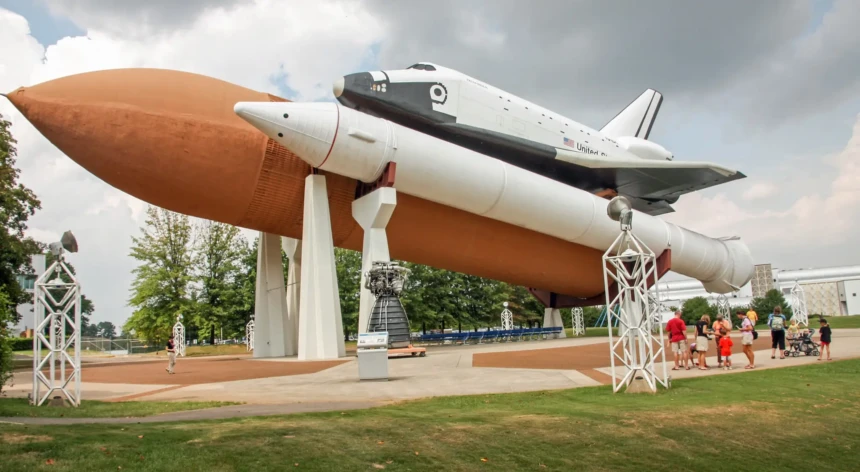
I spent six years in Huntsville, Alabama, where space isn’t abstract, it’s built at NASA’s Marshall Space Flight Center.
Rockets line the skyline. The Saturn V isn’t just a museum piece, it’s a reminder of what happens when engineering meets ambition.
That’s where I learned how NASA gets people to space.
New Jersey’s Space Legacy
New Jersey may not be known for launch pads, but it has produced some of NASA’s most notable astronauts:
- Buzz Aldrin – Born in Glen Ridge, second person to walk on the Moon (Apollo 11)
- Scott Kelly – Born in Orange, spent nearly a year aboard the International Space Station
- Mark Kelly – Born in Orange, Space Shuttle commander and later U.S. Senator
- Wally Schirra – Born in Hackensack, one of NASA’s original Mercury 7 astronauts
- Kenneth Ham – Born in Plainfield, Space Shuttle pilot and commander
From the earliest days of spaceflight to today, New Jersey has quietly been part of NASA’s story.
What I didn’t realize until much later was how they get them back.
I didn’t just read about it.
I watched it happen.
At 8:07 PM New Jersey time, Artemis II returned to Earth, capsule descending, parachutes deployed, and finally, splashdown.
It’s a moment most people only see as the end of a mission.
But it’s also where everything has to go right.
With Artemis II, NASA has taken its first crewed step back toward the Moon. The launch happened in Florida. Mission Control is in Houston. The engineering traces back to Huntsville.
But the ending?
That’s where the story shifts.
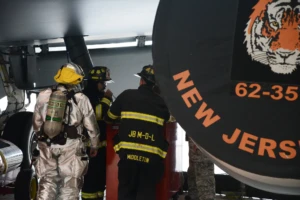
At Joint Base McGuire-Dix-Lakehurst, crews train for something most people never think about, what happens after the capsule hits the ocean.
Recovery isn’t a formality. It’s a race against time.
Aircrews practice locating capsules in open water, deploying markers, coordinating rescue teams, and securing astronauts quickly and safely.
It’s not glamorous.
It’s not televised.
But it’s mission-critical.
This is exactly what crews at JBMDL train for, not in theory, but for moments like this.
Because once that capsule hits the water, the mission isn’t over.
It’s handed off.
Huntsville builds the rocket. Florida launches it. Houston guides it.
And places like South Jersey help close the loop.
Because no mission is complete until everyone makes it home.
Somewhere out there, recovery teams moved in, trained, coordinated, ready.
And while they may not all be from South Jersey, places like JBMDL are part of the system that prepares them for that exact moment.
We may not have rockets on the horizon in Burlington County.
But tonight proved something.
When Artemis II came back from the Moon, there was already a network in place, trained and ready.
Not to send astronauts into space, but to make sure they returned from it.